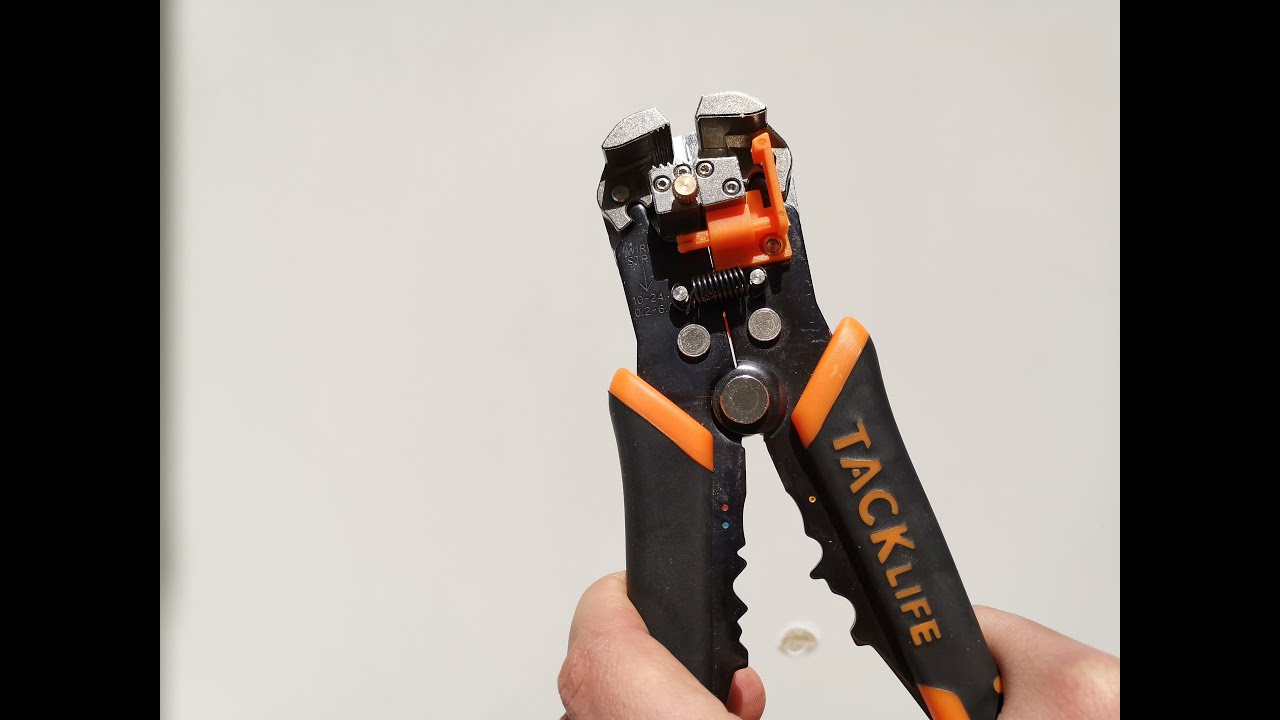
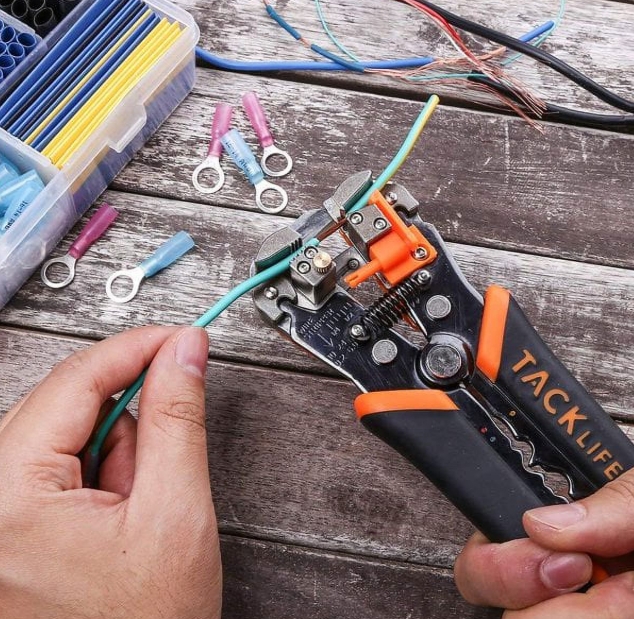
Tacklife Wire Stripper, Self-Adjusting 8.4 Inch Cable Cutter Crimper, 3 In 1 Multi Pliers – MWS02
- 3-In-1 Functions: Stripping, Cutting, Crimping. Crimp the insulated terminals 0.5-6mm² (10-22 AWG), non-insulated terminals: 0.5-6mm² (4-22 AWG), ignition terminals: 7-8 MM²; it can strip the wire of the specification on 0.2-6mm² (10-22 AWG), Meet your multiple operating needs
- Scientific Detail Design: 8-inch flexible springs and long plastic grips provide maximum leverage to reduce hand fatigue; automatic adjustment jaws, adjustable nuts and stoppers can be used to adjust the accuracy of the wire for different specifications, improving work efficiency
- Non-Slip Grip & Durable: Two-color TPR handle, non-slip and not easy to wear, gives you a comfortable grip experience; The use of heat-treated high-quality steel and the black steel ring increase the hardness, more durable and surer to be the best partner for a long-time work
- Widely Applied: Suitable for industrial, electrician and domestic. Stripping, cutting, and insulated terminal crimping of copper wire, aluminum wire, sheathed core wire, cable, multiple sheathed wires, bare terminal. Solve the problems of work and life, improving the quality of life for you
- What You Get: TACKLIFE MWS02 Wire Stripper x1, User Manual x1
$10.12
As I sit in my workshop surrounded by the organized chaos of tools, copper wire clippings, and half-finished electrical projects, I can’t help but reflect on how a single tool has completely transformed my DIY experience. Before discovering the Tacklife wire stripper, I was that person fumbling with a pair of dull scissors or a pocket knife, creating more hazards than solutions. Now, I approach each project with confidence, knowing that the right tool makes all the difference between professional results and amateur mistakes.
Let me take you through my personal journey with the Tacklife wire stripper, a tool that has become an extension of my hands and an essential companion in my electrical adventures.
The “Aha” Moment: Discovering Tacklife Wire Strippers
I still remember the frustration of my first major home wiring project. I was attempting to install new light fixtures throughout my house, and the process of stripping wires was becoming a nightmare. Nicked conductors, uneven strips, and the constant fear of electrocution had me questioning my decision to DIY.
Then a contractor friend stopped by and watched me struggle for about five minutes before shaking his head and reaching into his tool belt. “Try this,” he said, handing me his Tacklife wire stripper. The moment I used it, everything changed. Clean strips, perfect length, and no damage to the conductor—it was like watching magic happen in my hands.
The next day, I ordered my own, and I’ve never looked back. That was three years ago, and since then, I’ve completed dozens of electrical projects with professional-looking results that make me proud to show off my handiwork.
Understanding How the Tacklife Wire Stripper Works
At first glance, the Tacklife wire stripper might seem like just another tool, but its engineering tells a different story. Unlike basic wire cutters or multipurpose pliers, the Tacklife stripper is designed with precision in mind.
The tool features specially calibrated notches corresponding to different wire gauges. When you insert a wire into the appropriate notch and squeeze the handles, the sharp cutting edges slice through the insulation without damaging the metal conductor inside. Then, with a simple pull, the insulation slides off cleanly.
What makes the Tacklife model stand out is the precision of these notches. I’ve used other brands that either cut too deep (nicking the wire) or too shallow (leaving you to tug and pull at stubborn insulation). The Tacklife hits that sweet spot every time.
The handles are designed with ergonomics in mind, with comfortable grips that reduce hand fatigue during extended use. Trust me, when you’re wiring an entire home entertainment system, this feature becomes invaluable!
Features That Set Tacklife Wire Strippers Apart
After using various models over the years, I’ve come to appreciate certain features that make Tacklife stand out from the crowd:
1. Precision-Ground Cutting Edges
The cutting surfaces are made from hardened steel that stays sharp even after thousands of strips. I’ve had mine for three years now, and it still cuts as cleanly as the day I bought it. The precision grinding means that each cut is clean and consistent, which is crucial when you’re working with delicate electronics or high-current applications.
2. Multi-Functional Design
Most Tacklife models aren’t just strippers—they’re multitool powerhouses. Mine includes:
- Wire stripping notches for various gauges
- Cutting edges for clean wire cuts
- Crimping tools for different connector types
- Bolt cutters for small fasteners
- Looping holes for creating perfect wire loops
This versatility means I’m reaching for one tool instead of three or four, streamlining my workflow and saving valuable space in my toolbox.
3. Clear Gauge Markings
One feature I particularly appreciate is the clear, easy-to-read gauge markings. In poor lighting conditions (like when I’m working in the crawlspace under my house), being able to quickly identify the correct notch for my wire is invaluable. The markings on my Tacklife stripper have remained legible despite years of use and occasional contact with various chemicals and solvents.
4. Spring-Loaded Operation
The self-opening, spring-loaded mechanism reduces hand fatigue during repetitive stripping tasks. When I was rewiring my workshop, this feature saved my hand from cramping up after stripping dozens of connections.
5. Adjustable Stopper
For consistent strip lengths, the adjustable stopper is a game-changer. Set it once, and every wire is stripped to exactly the same length—perfect for professional-looking installations where consistency matters.
My Step-by-Step Guide to Using a Tacklife Wire Stripper
Over the years, I’ve refined my technique for getting the most out of my Tacklife stripper. Here’s my personal method:
1. Identify Your Wire Gauge
Before cutting, I always check the wire gauge. This might be printed on the wire insulation or you might need to reference a wire gauge chart. Most residential wiring uses 12 or 14 AWG for circuits, while smaller electronics might use 18 AWG or higher numbers (remember, the higher the AWG number, the thinner the wire).
2. Select the Correct Notch
Match your wire gauge to the corresponding notch on the stripper. Most Tacklife models have clearly marked gauge sizes ranging from 10-24 AWG, covering most home and automotive applications.
3. Position the Wire Correctly
I insert the wire perpendicular to the tool, making sure it’s seated fully in the notch. If you’re using the adjustable stopper, position the wire against it for a consistent strip length.
4. Apply Even Pressure
Close the handles with steady, even pressure. You’ll feel a slight resistance as the blades cut through the insulation, followed by a reduction in resistance once they’ve penetrated to the proper depth.
5. Pull to Remove Insulation
While maintaining pressure on the handles, pull the tool away from the wire (or the wire away from the tool). The insulation should slide off cleanly, revealing a perfectly intact conductor.
6. Inspect Your Work
Always take a moment to inspect the stripped wire. A perfect strip will have no nicks in the conductor and no remaining insulation in the stripped section.
I remember spending an entire weekend troubleshooting an intermittent connection in my home theater system, only to discover that a poorly stripped wire was causing the issue. Since switching to the Tacklife and following this method, I haven’t had a single connection failure.
Price Point: Is the Tacklife Wire Stripper Worth the Investment?
When I first looked into purchasing a quality wire stripper, I experienced some sticker shock. Coming from the world of $5 generic tools, the Tacklife’s price range of $15-35 (depending on the model) seemed steep.
However, after using it for just one major project, I realized it was one of the best investments I’ve made in my tool collection. Let’s break down the value proposition:
Entry-Level Models ($15-20)
These basic Tacklife strippers handle common wire gauges and include fundamental features like cutting edges and spring-loaded operation. They’re perfect for occasional DIYers or those just starting their tool collection.
I started with an entry-level model when rewiring my garage, and it performed admirably for basic household wiring tasks.
Mid-Range Models ($20-25)
The sweet spot for serious DIYers like myself. These models include additional features like crimping capabilities, more gauge options, and better ergonomics. My current model falls in this category, and it’s been perfect for everything from automotive wiring to home electrical projects.
Professional-Grade Models ($25-35)
These top-tier Tacklife strippers include all the bells and whistles: precision-adjustable stripping lengths, specialized crimping dies, premium materials, and extended warranty coverage. If you’re doing electrical work regularly, these models are worth the extra investment.
A contractor friend who visits occasionally always eyes my Tacklife with approval, noting that it performs comparably to his $50+ professional brand. The value-to-performance ratio of Tacklife products consistently exceeds expectations, making them an excellent choice for both hobbyists and professionals.
Professional Enough? My Experience Using Tacklife in Commercial Settings
Though I started as a weekend warrior, I’ve since taken on some side jobs helping friends with their businesses. This has given me the opportunity to put my Tacklife stripper through more demanding paces.
During a recent job rewiring a small office, I worked alongside a licensed electrician who brought his own high-end strippers. Throughout the day, we compared notes on our tools, and I was pleased to find that my Tacklife performed just as well as his premium brand for most tasks.
Where professional electricians might find limitations:
- The very heaviest gauge wires (8 AWG and thicker) can be challenging for some Tacklife models
- For extremely high-volume work, the ergonomics of specialized professional tools might reduce fatigue
- Some specialized applications might require features not found on most Tacklife models
That said, for 90% of professional electrical work, a quality Tacklife stripper is more than adequate. I’ve completed commercial lighting installations, automotive wiring harnesses, and complex home automation systems with mine, all with professional-quality results.
Versatility: Handling Different Wire Sizes with Ease
One of the most impressive aspects of my Tacklife stripper is its ability to handle a wide range of wire sizes without adjustment or tool changes. My model accommodates wires from 10-24 AWG, covering everything from thick power supply lines to delicate electronic connections.
I recently took on a project installing a smart home system that involved a mix of high-voltage power wiring (12 AWG), intermediate security system wiring (16 AWG), and delicate data cables (22 AWG). Being able to switch between these different gauges without changing tools saved countless minutes that would have added up to hours over the course of the project.
The precision of each notch is remarkable. When stripping 22 AWG wire for delicate sensor connections, the tool removes just the right amount of insulation without stressing the thin copper strands. Equally impressive is its ability to cleanly strip the tough insulation on 10 AWG power cables without requiring excessive hand strength.
Fine-Tuning: Adjusting Your Tacklife for Precision Stripping
While the Tacklife works beautifully out of the box, I’ve learned a few tricks for adjusting it to achieve even better results:
1. Tension Adjustment
Many Tacklife models include a small screw that adjusts the tension between the handles. I’ve found that slightly looser tension works better for delicate wires, while tighter tension gives more control when working with tougher insulation.
2. Stop Adjustment
For consistent strip lengths, the adjustable stop is invaluable. I typically set mine to expose 3/8″ of conductor for standard electrical connections, but will adjust it to 1/4″ for more compact electronic work. Take the time to set this precisely—it pays dividends in professional-looking results.
3. Breaking In the Tool
New Tacklife strippers can sometimes feel a bit stiff. Rather than forcing them, I worked mine through its full range of motion repeatedly with no wire inserted. After about 50 cycles, the action became noticeably smoother without compromising precision.
4. Occasional Lubrication
A tiny drop of light machine oil applied to the pivot point every few months keeps the action smooth and prevents corrosion, especially if you work in humid environments like I do.
These small adjustments have helped me get the absolute most out of my tool, ensuring consistent performance across various wire types and applications.
Real-World Performance: What Users Are Saying
When I first purchased my Tacklife stripper, I relied heavily on online reviews to guide my decision. Now, having become something of an evangelist for the brand, I find myself frequently discussing these tools with fellow DIYers and professionals.
The consensus among my network aligns closely with my own experience:
Positive Feedback Patterns
- Durability stands out as a key advantage, with many users reporting years of reliable service
- The price-to-performance ratio consistently exceeds expectations
- Versatility across different wire types and applications earns high marks
- Comfortable ergonomics make extended use pleasant rather than painful
Occasional Criticisms
- Some users with very large hands find certain models slightly small for comfort
- The spring mechanism has been reported to weaken over time in a small percentage of units
- The cutting edges may require occasional sharpening with heavy professional use
One particularly telling review came from a friend who works as a maintenance supervisor for a large apartment complex. After borrowing my Tacklife for a day, he ordered six units for his team, replacing their previous brand. Six months later, he reported that his team’s efficiency on wiring tasks had noticeably improved, and they hadn’t had a single tool failure despite daily use.
Where to Purchase: Finding the Best Deal on Tacklife Wire Strippers
When I decided to purchase my Tacklife stripper, I spent some time researching the best places to buy. Here’s what I’ve learned about where to find these tools, along with typical pricing patterns:
Online Retailers
Major online marketplaces like Amazon, eBay, and Walmart.com typically carry the full range of Tacklife products. Amazon in particular often has competitive pricing and the benefit of detailed user reviews to help guide your selection.
Home Improvement Stores
Chains like Home Depot, Lowe’s, and Menards sometimes carry Tacklife products, though their selection may be more limited than online options. The advantage here is being able to hold the tool before purchasing.
Direct from Manufacturer
Tacklife’s own website occasionally offers special promotions and bundles not available elsewhere. They also provide the most comprehensive information about each model’s specifications.
Price Comparison Tips
I’ve noticed that prices can vary by as much as 30% between retailers, so it pays to compare. Additionally, Tacklife products are frequently included in tool sales around major holidays, making those excellent times to purchase.
When I bought my current model, I waited for a Black Friday sale and saved about 25% off the regular price. The patience paid off, allowing me to purchase a higher-end model than I had originally budgeted for.
Maintenance Matters: Keeping Your Tacklife Wire Stripper in Prime Condition
One of the reasons my Tacklife stripper has lasted so long is my commitment to proper maintenance. These tools aren’t particularly demanding in terms of care, but a few simple practices have kept mine working like new:
1. Regular Cleaning
After each significant project, I wipe down the tool with a clean cloth to remove any copper dust, insulation debris, or contaminants. For more thorough cleaning, I use a small brush (an old toothbrush works perfectly) to clean between the teeth and in the pivot mechanism.
2. Proper Storage
I store my stripper in a dry tool chest, separate from tools that might damage its cutting edges. A simple habit, but one that prevents unnecessary wear and tear.
3. Occasional Lubrication
Every 3-4 months, I apply a tiny drop of light machine oil to the pivot point and work the handles through their full range of motion several times. This keeps the action smooth and prevents corrosion.
4. Edge Maintenance
While the hardened steel edges maintain their sharpness remarkably well, they can eventually dull with heavy use. Rather than attempting to sharpen the precision-ground notches (which could alter their carefully calibrated dimensions), I’ve found it’s better to replace the tool when it eventually begins to show signs of dullness—though this hasn’t been necessary for me even after three years of regular use.
5. Avoid Misuse
Perhaps the most important maintenance tip is simply using the tool as intended. I never use my wire stripper as a general-purpose cutter or plier, which would quickly damage its precision edges.
Warranty Protection: Understanding Your Coverage
When investing in a quality tool, warranty coverage provides valuable peace of mind. Tacklife stands behind their products with solid warranty protection:
Most Tacklife wire strippers come with a 24-month warranty covering manufacturing defects and material failures. This is fairly generous compared to the 12-month coverage offered by many comparable brands.
In my experience and research, Tacklife’s customer service has a good reputation for honoring warranty claims without excessive hassle. While I’ve never needed to make a claim myself (testament to the durability of their products), several online reviews mention positive experiences with their warranty service.
To ensure your warranty protection:
- Keep your original purchase receipt
- Register your product on the Tacklife website when possible
- Use the tool as intended for its designed purpose
The warranty excludes normal wear and tear, as well as damage from misuse, which is standard for tool warranties. However, any legitimate defects in materials or workmanship should be covered during the warranty period.
Pros and Cons: An Honest Assessment After Years of Use
After extensive use across dozens of projects, I’ve developed a clear picture of the Tacklife wire stripper’s strengths and limitations:
Pros
- Outstanding value for money compared to similar tools
- Excellent durability that stands up to regular use
- Versatile functionality beyond simple wire stripping
- Precise, clean strips that don’t damage conductors
- Comfortable ergonomics that reduce hand fatigue
- Clear gauge markings that remain legible over time
- Robust construction from quality materials
Cons
- Some models struggle with very thick wires (8 AWG and larger)
- The spring mechanism can occasionally weaken over time
- Limited availability in physical retail stores
- Some users report slightly less refined finish compared to premium brands
- Certain models lack specialized features found on high-end professional tools
In balancing these factors, the pros substantially outweigh the cons for most users. The limitations become relevant primarily for professional electricians working with specialized applications or extremely high volumes.
For my needs as a serious DIYer who occasionally takes on commercial projects, the Tacklife offers an ideal balance of performance, durability, and value.
Brand Comparison: How Tacklife Stacks Up Against Competitors
The wire stripper market is crowded with options ranging from bargain-bin generics to premium professional brands. Having had the opportunity to use several different brands through friends and job sites, I can offer some comparative insights:
Tacklife vs. Budget Brands (Under $15)
Tacklife substantially outperforms generic budget options in almost every category:
- Much more precise cutting edges that don’t damage conductors
- Significantly longer tool life
- Better ergonomics for comfortable extended use
- More consistent performance across different wire types
Tacklife vs. Mid-Range Brands ($15-25)
Against comparable mid-range competitors like Irwin and Klein’s entry-level options:
- Similar performance characteristics
- Roughly equal durability
- Tacklife often offers more features at the same price point
- Ergonomics vary by specific model, with personal preference playing a role
Tacklife vs. Premium Brands ($30+)
When compared to high-end professional brands like Klein’s premium lines or Knipex:
- Professional brands may offer marginally better precision
- Premium options typically last longer under heavy daily use
- Professional tools sometimes include specialized features for niche applications
- The performance gap rarely justifies the 2-3x price difference for most users
A specific example: While working alongside an electrician friend with a $45 Klein stripper, we compared results on identical 14 AWG copper wire. The strips were virtually indistinguishable in quality, though his tool was slightly smoother in operation. For occasional to regular use, I can’t justify the premium price for the marginal improvement.
Beyond Stripping: Cutting Capabilities of the Tacklife Wire Stripper
While stripping is its primary function, the cutting capabilities of my Tacklife have proven equally valuable across numerous projects:
The integrated cutting edge is precision-ground and capable of cleanly cutting copper and aluminum wiring up to 10 AWG (in my model). The cut is crisp and square, without the crushing or deformation sometimes seen with improper cutting tools.
I particularly appreciate the cutting edge placement, which allows for cuts in tight spaces where traditional wire cutters might not fit. When installing recessed lighting in my kitchen, this feature proved invaluable for trimming wires in the confined space of the ceiling junction boxes.
The cutting performance remains impressive even after years of use. While not quite as effortless as when new, my three-year-old Tacklife still makes clean cuts with minimal hand pressure. For comparison, I have a generic wire cutter of similar age that now crushes wires more than it cuts them, making the Tacklife’s durability all the more impressive.
One limitation worth noting: while adequate for occasional use, the cutting edge isn’t designed to replace dedicated wire cutters for high-volume cutting work. For my massive workshop rewiring project, I eventually switched to dedicated cutters after about 50 cuts to reduce hand fatigue.
Finding Your Match: Selecting the Best Tacklife Wire Stripper for Home Use
With several models available, choosing the right Tacklife stripper for home use requires considering your specific needs. Based on my experience and conversations with other users, here’s my guidance:
For Occasional DIYers
The basic Tacklife SWS01A offers excellent value for those who only need to strip wires occasionally. It handles common household wire gauges (10-22 AWG) and includes basic cutting functionality—perfect for simple repairs and small projects.
For Serious Home Improvers
The mid-range Tacklife MWS02 (my personal choice) adds crimping capabilities and improved ergonomics. If you tackle several electrical projects per year or work with a variety of wire types, this model offers the best balance of features and value.
For Advanced DIYers with Specialized Needs
The premium Tacklife SWS03 includes additional features like a precision adjustment mechanism and specialized crimping dies for automotive connectors. If your projects frequently involve automotive wiring, data cables, or alarm systems, these features justify the higher price.
I initially purchased the basic model but upgraded to the mid-range option after about six months as my projects became more ambitious. The additional features—particularly the crimping capability and wider gauge range—have proven well worth the modest price difference.
Troubleshooting Tips: When Your Tacklife Wire Stripper Isn’t Performing
Even the best tools occasionally encounter issues. Over the years, I’ve developed some troubleshooting approaches for common problems:
Problem: Wire insulation isn’t stripping cleanly
Solutions I’ve found effective:
- Verify you’re using the correct gauge notch for your wire
- Check for debris caught in the stripping notch
- Ensure you’re applying even pressure to both handles
- Try rotating the wire slightly before stripping
Problem: Cutting edge isn’t performing well
My troubleshooting approach:
- Clean the cutting edges with a small brush
- Check for any nicks or damage
- Make sure you’re not attempting to cut materials harder than copper or aluminum
- Position the wire closer to the pivot point for better leverage
Problem: Spring mechanism feels weak or inconsistent
What’s worked for me:
- Clean the pivot area thoroughly
- Apply a small drop of lubricant
- Work the handles through their full range of motion several times
- Check for any debris interfering with the spring
Problem: Tool feels stiff or catches during operation
My solutions:
- Check for proper alignment of the handles
- Apply lubricant to the pivot point
- Inspect for any bent components
- Work the handles through their range of motion with no wire inserted
These simple troubleshooting steps have resolved almost every issue I’ve encountered, though it’s worth noting that the Tacklife has been remarkably reliable overall. Most problems I’ve experienced were the result of debris accumulation or attempting to strip wire gauges outside the tool’s specified range.
Automotive Applications: Using Tacklife Wire Strippers for Vehicle Projects
One area where my Tacklife stripper has proven particularly valuable is in automotive electrical work. Vehicle wiring presents unique challenges with its variety of wire types, tight spaces, and critical reliability requirements.
I recently undertook a complete stereo system installation in my SUV, including an amplifier, subwoofer, and new speakers throughout. This project involved working with:
- Power cables (8 and 10 AWG)
- Signal wires (18 AWG)
- Speaker wires (16 AWG)
- Delicate sensor connections (22 AWG)
The Tacklife handled everything except the thickest power cable with precision and ease. The ability to quickly switch between different gauge sizes saved significant time, especially when working in the cramped spaces behind the dashboard.
The crimping feature proved invaluable for creating reliable connections that could withstand vehicle vibration. For automotive work, I particularly appreciate the durability of the Tacklife’s construction—when you’re lying under a dashboard with limited visibility, the last thing you need is a flimsy tool that flexes or slips.
One automotive-specific tip I’ve learned: when working with factory wiring harnesses, the Tacklife’s precision is crucial. Modern vehicles often use thin-walled insulation that’s easily damaged by less precise tools, potentially creating short circuits that are extremely difficult to diagnose later.
Safety First: Essential Precautions When Using Wire Strippers
While wire strippers are relatively safe compared to many power tools, proper safety practices remain important. Here are the safety habits I’ve developed over years of electrical work:
1. Always Verify Power is Off
Before working on any electrical circuit, I verify it’s de-energized using a reliable voltage tester. No wire stripper, regardless of brand, is designed for use on live circuits.
2. Proper Eye Protection
Wire insulation can occasionally spring away unexpectedly when stripped, and copper clippings are hazardous to eyes. I always wear safety glasses during electrical work.
3. Correct Tool Orientation
I keep the cutting edges pointed away from my body and maintain awareness of where my fingers are relative to the cutting surfaces.
4. Appropriate Work Surface
Working on a stable, well-lit surface reduces the chance of slips and errors. I use a rubber mat on my workbench for electrical projects to prevent small components from rolling away.
5. Proper Disposal of Wire Ends
I keep a small container specifically for collecting wire clippings and stripped insulation, preventing sharp copper ends from creating hazards in the workspace.
These simple precautions have helped me maintain a perfect safety record through hundreds of electrical projects. While the Tacklife’s design incorporates safety features like rounded external edges, responsible use remains the user’s responsibility.
Material Compatibility: What Can Your Tacklife Stripper Handle?
Understanding the material limitations of your tools prevents damage and ensures optimal performance. Through experience, I’ve identified which materials work well with the Tacklife stripper:
Compatible Materials
- Copper wire (solid and stranded): The Tacklife handles both with equal precision
- Aluminum wire: Works well, though it requires slightly less pressure than copper
- Tinned wire: Strips cleanly without damaging the tinning
- Standard plastic and rubber insulation: Cuts through smoothly and cleanly
Materials to Approach with Caution
- Very thin-walled insulation: Requires a delicate touch to avoid nicking the conductor
- Specialty high-temperature insulation: Sometimes requires more force and may not strip as cleanly
- Shielded cable: The shielding can complicate stripping and may require preliminary preparation
Materials to Avoid
- Steel wire: Too hard for the cutting edges, will damage the tool
- Very large gauge wires (beyond the tool’s specifications): Forces the tool beyond its design parameters
- Non-wire materials: Using the tool to cut zip ties, plastic, or other materials will damage the precision edges
I learned about these limitations primarily through experience. Early in my DIY journey, I attempted to use my stripper on some steel picture hanging wire, resulting in a small nick in one of the cutting edges that affected its performance on smaller gauge wires. Lesson learned!
Expanding Capabilities: Accessories for Your Tacklife Wire Stripper
While the Tacklife wire stripper is impressively versatile out of the box, I’ve found a few accessories that complement it perfectly:
1. Carrying Case
Though not specifically designed for the Tacklife, I use a small padded tool pouch that protects the precision edges during transport and storage. This has been particularly valuable when taking my tools to help friends with projects.
2. Wire Gauge Measurement Tool
A simple wire gauge measurement card helps me quickly identify unlabeled wire sizes, ensuring I use the correct notch on the stripper. This $5 accessory has prevented countless errors.
3. Precision Screwdriver Set
For adjusting the tension screw and stopper on the Tacklife, a set of precision screwdrivers ensures I don’t damage these small components during adjustments.
4. Connector Assortment
Not strictly an accessory for the tool itself, but I keep a well-organized case of various connectors that pair perfectly with the Tacklife’s crimping capabilities. Having the right connectors on hand makes every project go more smoothly.
5. Helping Hands Tool
When working on complex connections, a “helping hands” tool with adjustable clips holds wires steady while I strip and connect them. This simple accessory has dramatically improved my efficiency on intricate projects.
These complementary tools and accessories have helped me get the absolute most from my Tacklife stripper, creating a complete wire preparation system rather than just a single tool.
Final Thoughts: Why the Tacklife Wire Stripper Earns Its Place in My Essential Tool Kit
As I look back on my journey with the Tacklife wire stripper, from tentative beginner to confident electrical DIYer, I’m struck by how significantly this single tool has impacted my capabilities. What started as a simple purchase has become an essential part of my approach to projects.
The Tacklife’s combination of precision, durability, and value has consistently exceeded my expectations. Whether I’m working on delicate electronics, home wiring, or automotive projects, it delivers professional results that make me proud of my work.
Perhaps most importantly, it’s helped transform electrical work from a source of frustration to a genuinely enjoyable aspect of my DIY repertoire. There’s a certain satisfaction in creating clean, professional connections that function flawlessly, and the right tool makes that satisfaction accessible even to those of us who don’t wire houses for a living.
If you’re on the fence about investing in a quality wire stripper, I hope my experience helps guide your decision. The right tool makes all the difference between professional results and amateur mistakes—and the Tacklife wire stripper is definitely the right tool.
From one maker to another, I wish you clean strips, solid connections, and the confidence that comes from having the right tool in your hands.